






Resource
Community Connectors spotlight: Megan Oliver, senior planner in Baltimore, MD
Community Connectors spotlight: Megan Oliver, senior planner in Baltimore, MD
SGA’s Community Connectors is a year-long program that supports teams in three small and mid-sized communities as they work to repair divisive infrastructure, improve safety outcomes, and advance lasting community reconnections. The program centers collaboration by bringing together community-based organizations with local government partners in learning sessions and hands-on workshops for quick-build demonstration projects.
At its core, Community Connectors is about people. Our new blog series highlights the participants leading this work, offering a glimpse into how their journeys began and how deeply their commitment now runs. In this second round of participant profiles, we are featuring Connectors who work in city government.
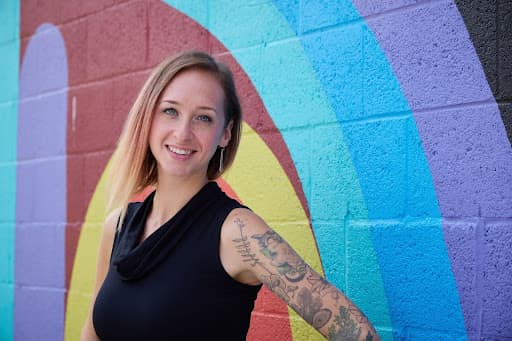
Get to know Megan Oliver, a co-lead for Historic East Towson, MD, in this year’s Community Connectors program. Megan is a senior planner at the Baltimore County Department of Planning.
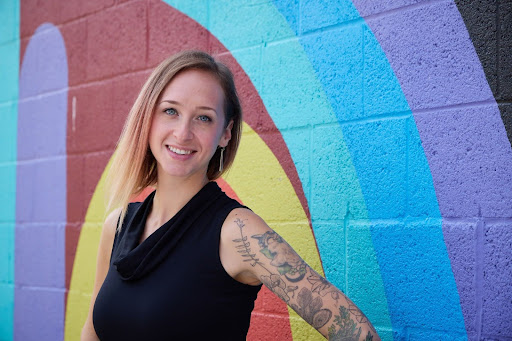 Photo courtesy of Megan Oliver.
 The conversation below has been condensed and lightly edited.
What got you interested in planning, transportation, and reconnection?
I went to school for interior design, and I slowly scaled that up to architecture, and ultimately, urban design. I've been steeped in this ethos that favors walkability and bikeability over cars for decades at this point. But what's most important to me is that I feel a sort of calling in the work that I do. I know that we are each individually impacted on such deep levels, emotionally and physically, by the spaces that we spend time in. I feel driven to try to shape the built environment in ways that make us feel good, that bring us joy. Car-oriented spaces just don't do that. I know that to foster really healthy and happy communities, we need people to feel connected to one another, to the world around them.
Research has actually shown that we are healthier and more resilient when we are in community, so my work is all about finding opportunities to bring people together in community, to foster joy, and to remove whatever it is that's standing in the way of boosting community happiness. In Towson, the bypass is a huge barrier for the Historic East Towson community. The community fabric there is already really strong, despite the fact that this bypass has cut through, and I can just imagine how much more robust Historic East Towson will be once these roads become seams instead of divisions.
What are you excited to bring to the cohort? What past experience do you want to share that the teams can learn from?
My background in urban design has afforded me a lot of opportunities to work on cool projects. Parking Day, or planning an event to take over parking spots and create spaces for people instead of cars, was often a big part of my year. Through participating in a number of Parking Days, I slowly was able to build more familiarity and comfort with temporary activations of spaces, and I think that's really going to shape how we look at the program and engage people with the Towson project.
I had a chance to work on the Belair-Edison Main Street with a group called EnviroCollab out of Baltimore to create outdoor spaces for people to engage with businesses safely while keeping a distance during Covid-19. These projects where I've had to think creatively and resourcefully about how to fill, design, and program a space gives me some experience and an understanding of what's possible, but by no means do I think that I have everything.
What is something you’ve learned so far from this program that you want other people to know?
The greatest lesson that I've taken away at this point is to not overthink anything and just do it. Make sure you're following the right steps, of course, but don't let the idea become too burdensome. Don't worry about how to do an asphalt art project because it's absolutely within your reach, and you might be surprised at how easy it actually is.
What advice would you have for someone looking to start a project like this in their own community?
To get the ball rolling on a project like this—and to be able to get to a point where we're able to make some big changes in how things are done and shift the status quo—really requires starting with building relationships. First, start with the community around a space. Having all of those people on your side makes your collective voice that much stronger, so that you can come to officials, to public staff, to potential partners, and be able to be strong advocates for what it is that you want.
What does success look like to you?
Success for our project, for me, is creating a space that gives members of the Historic East Towson community a chance to be with one another and use the land of their community in a way that it hasn't been able to be used in a very long time. Since the bypass has come in, that area has been taken from the community as a space that could be serving their recreational needs and social needs through block parties, group dinners, or whatever that might be. Success in the Historic East Towson project is giving the land back to the community, reclaiming that space for people, and keeping the cars in their lane away from the people, and really prioritizing the experience of the residents.
What sort of legacy do you want to leave behind in your work?
I hope my involvement in this project paves the way for more work like this to happen throughout Baltimore County. I recognize that it's a challenge in our community, and in many communities, to be able to do something as simple as reclaiming the space for people and to just create a little bit of art, creativity, and liveliness. What I really hope my involvement in this project is able to do is demonstrate to others in Baltimore County, both on the government side of things, but also other residents throughout the county—who come by, drive through, and see stories of this in the news—and get a foot in the door so that we can have more opportunities like this in the future.
What’s one go-to resource every person doing this work should have in their toolbox?
Pinterest. It's such a mundane resource, but being able to see what's possible and what's happening elsewhere in the world can really fuel my creative juices and help me feel like the big changes are more within my reach than maybe I initially thought.
Livable places. Healthy people. Shared prosperity.


© 2026 Smart Growth America. All rights reserved
Site By3Lane Marketing
