




News
By Raveena John, Eric Cova, October 7, 2026
Have you ever noticed a dangerous street in your community that needs to be changed, but you don’t know where to start? That happened to our friend Scott in Rockford, Michigan, earlier this summer. Follow this step-by-step guide based on Scott’s example to learn how to advocate for urgently needed street changes in your own front yard.
Anyone who’s gotten behind the wheel of a car knows the experience: You’re heading home on a street you know, your windows are open, your music is playing, and you glance down and realize you’ve been driving ten miles above the speed limit. Maybe even fifteen. And you only noticed because you meant to check how much gas you had left.
I’m not speeding on purpose, and neither are you. We drive in response to the signals we’re getting from the street. A wide open road encourages us to press the gas pedal, even when we don’t mean to speed.
What this looks like from behind the wheel


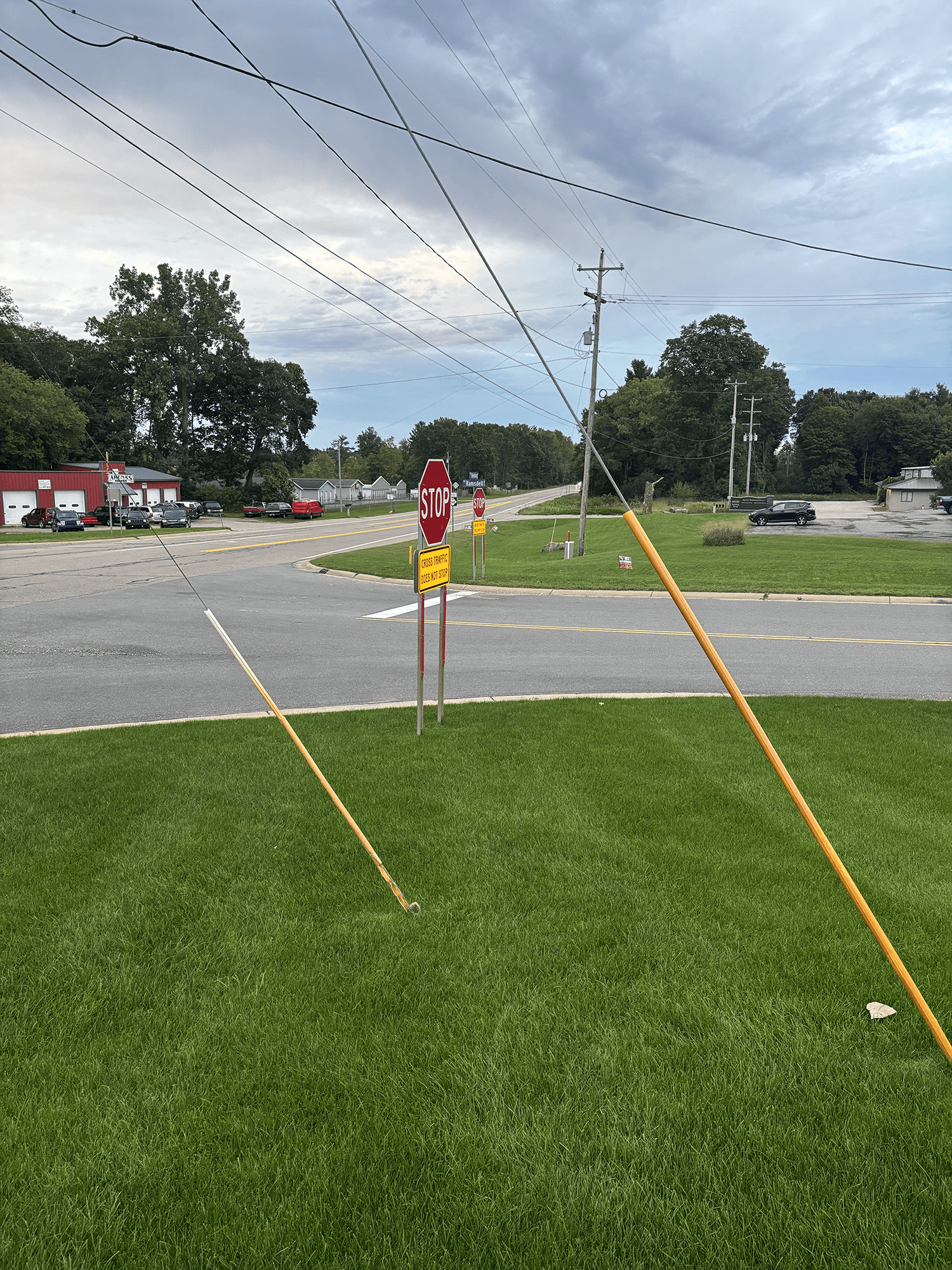
Our friend Scott knows that feeling particularly well. He regularly drives through the intersection of Belding Road and Ramsdell Drive outside Rockford, Michigan, and depending on which road he’s on, it can feel like two completely different places.
On Belding, the speed limit is 55 mph, but the road gives you every indication that you can go faster. It’s wide and open, and as you come down a large hill toward Ramsdell, there’s little to signal that you’re approaching an intersection where you might need to slow down or pay closer attention. Scott has caught himself speeding there more than once without even realizing it.
But Scott has also experienced that intersection from the other side. When he’s driving north on Ramsdell and needs to turn left onto Belding, he has to watch for fast-moving traffic coming from both directions on Belding, cars next to him trying to go straight or turn right, and cars approaching from the opposite direction. There’s no traffic light, and the stop signs are only on Ramsdell. The hill also limits how much time drivers have to see and react to one another.
There are so many variables that Scott avoids making that turn when he can, often choosing to take a longer route. When his kids are in the car, he even tells them to be quiet so he can concentrate.
That’s the contradiction: Scott has been the driver unintentionally speeding down Belding and the driver on Ramsdell worried that someone doing exactly the same thing won’t see him in time. The problem isn’t that drivers suddenly become more or less responsible depending on which road they’re on. It’s that the design of the intersection asks people to drive fast in one direction while demanding extreme caution from everyone trying to cross it.
So what can you do?
Scott knows there’s a problem at this intersection. But knowing a street feels unsafe and knowing how to actually change it are two different things.
Let’s say you’re tired of accidentally going over the speed limit. Maybe there’s a school nearby, and you know it’s especially important for drivers to be careful here. Maybe there’s a park or a playground, and your family would like to walk there together more safely. Or maybe you’re just fed up with risking a speeding ticket. What steps can you take to make a change to this street? How do you get started?
Step 1: Figure out who owns the road
Streets are typically owned by the city, county, or state. Sometimes a road will be privately owned, such as in gated communities. Sometimes the entity that owns the road is not responsible for maintenance, but to get started, let’s just figure out if it’s a city or county road or a state road, so we know who to contact about the issue you’ve spotted. If you find it’s a local road, owned by the city or county, proceed to Step 2a. If it’s a state route, go to Step 2b. If it’s an intersection with both, go to both.
You can sometimes figure out who owns a road by looking at a map online. If it’s labeled using numbers with a circle around them, there’s a good chance it’s a state-owned road. If it has a blue and red shield, that’s probably an interstate highway, which is also state-owned.
If you just see road names with no numbers or symbols, it’s likely a locally owned road. Using Scott as an example, we can see the intersection he identified appears to be both a state road (M-44/Belding Road NE) and a local road (Ramsdell Drive NE).

If you want to be sure, dig around your state department of transportation’s (DOT) website for maps of state routes to see if your road shows up. It’s a little hard to see, but this map of State Owned Roads in Michigan confirms what we guessed: M-44/Belding is owned by the state, and Ramsdell is locally owned.

So who’s the local owner, the county or a city? A bit more digging will also reveal which is responsible for roads in your community. Back to Scott’s example: Google Maps shows that this intersection is within Cannon Township, so it looks like there isn’t a city to own this road.
Now let’s do a quick search on Cannon Township and Kent County to see whether either has a transportation department: The Cannon Township Supervisor is “responsible for overseeing the condition of roads within the Township and works closely with various city, county, and state organizations to coordinate road improvements.” The Kent County Road Commission (KCRC) works to “construct, maintain and preserve” the road network “while collaborating with our townships and responding to the public’s needs,” and its official road map confirms that Belding is a state route and Ramsdell is a county road. So it looks like Kent County is what we’re looking for. We’re going to Step 2a and Step 2b.
Step 2a: Contact your city or county
Now that you know this road is their responsibility, let your local government know!
There are many different ways to contact the city, and your mileage may vary with these guidelines, depending on the structure of your local government. In general, start with the website contact form or local 311. These are the most basic ways to get in touch with your city and are good catch-alls for raising issues. For example, Scott would go to the “Contact Us” page on the KCRC website and share their issue via the Contact Form.

If the issue should be elevated or if you’d like to do more, consider reaching out to your local elected official or the local department responsible for streets, likely public works or transportation. A short message with your observations may raise an issue they are not aware of or may prioritize an issue already on their list.
Step 2b: Contact your state DOT
If this is an issue on a state route, find a similar contact form for your state DOT. Scott would go to the “Contact MDOT” page to find the right email address to raise the issue. Your state DOT may have a contact form or a community liaison to directly reach out to.

If you want to go a bit further, find a bike or pedestrian coordinator, regional contact, or safety engineer in your state DOT to send your observations to. State DOTs are responsible for so many miles of road they cannot know exactly what is going on everywhere, so your lived experience will be valuable insight. Prepare yourself to be patient, however, as these agencies are not known for moving quickly. Which brings us to Step 3.
Step 3: Find advocacy groups in your area
You are probably not the first person who wants to change the transportation system in your area. Making a change, whether at Scott’s intersection or a street in your own community, is more effective with greater numbers. Look for a local bike or pedestrian advocacy group or other community organization with a mission that includes improving street safety and active transportation in your area.
There may be regional or state organizations (such as Transportation for Massachusetts) or local chapters of national groups (like Families for Safe Streets) that you could get in touch with, too. Let them know about the issue you’ve identified and see if you’d like to get involved. There’s always a need for more volunteers, and raising this issue may spark your interest in fighting for bigger change and better streets that work for everyone.
Have a street like this in your community?
Do you have a street or intersection that makes you feel like Scott does? Use the steps above to raise your safety concerns with the people responsible for your roads, and then let us know what happens. We’d love to hear about your experience: Did your city, county, or state respond? What did they say? And, most importantly, did they make any changes to address your concerns?
Related News







Livable places. Healthy people. Shared prosperity.


© 2026 Smart Growth America. All rights reserved
Site By3Lane Marketing
