







News
By Chris Rall, April 6, 2026
After 16 years with Smart Growth America and Transportation for America, here are some things I’ve learned along the way.
When SGA hired me as the Oregon field organizer for the Transportation for America campaign in 2010, I had some experience with local transportation and housing advocacy, but was brand-new to federal issues. This was the first time I had direct access to colleagues who were national experts on these topics. I had the opportunity to talk with local elected leaders, agency staff, and advocates in Oregon, and eventually, across the country as my responsibilities and turf expanded.
Needless to say, I’ve learned a lot in the last 16 years and want to take the opportunity to share a few. Here are three things that jumped out as the most important.
1. Leaders need to catch up with the market
More Americans want to live in vibrant, walkable, bikeable, transit-accessible communities than we have built. SGA has demonstrated this in a variety of ways, including our Foot Traffic Ahead reports and reports on the economic value of Complete Streets. Not only this, but polls also show that Americans recognize the futility of widening highways to cure congestion.
Unfortunately, most leaders are out of touch with this reality, especially in Congress. Members of Congress are, on average, older, whiter, and wealthier than average Americans. U.S. Senators and other statewide elected officials are typically wildly out of touch with what their constituents want. One reason is that many of them consider what their state DOT says to be the only opinion worth listening to on transportation. That’s like asking Shaquille O’Neal for advice on how to play soccer. While many state DOTs are evolving, they were originally tasked with building our now-completed highway system. Unfortunately, they are interminably slow to recognize the diminishing returns and futility of continued highway widening, even though most Americans do. Instead, they usually either fail to educate state-level decisionmakers on the downsides and wastefulness of widening highways, or worse, actively advocate for highway expansion.
Leadership really matters, and having elected leaders who “get it” makes a big difference. We’re starting to see more and more outstanding elected leaders, particularly at the local level. Just to name a few, I’ve had the chance to work with: Former Emeryville Mayor John Bauters, who worked with his council member colleagues to staff the city with planners and engineers who are rapidly building out Dutch-quality complete streets and ample affordable housing. Cambridge, MA, City Council member Burhan Azeem led a successful effort to end single-family zoning to build more housing. State Sen. Khanh Pham helped transfer ownership of one of the most dangerous streets in Oregon from the state DOT to the City of Portland with funding for safety improvements, medians with trees to diminish heat island effects, and major progress toward the city's second bus rapid transit line. A few leaders whom I never had a chance to meet also come to mind: State Sen. Scott Weiner has advanced countless bills substantially moving the needle on California’s housing crisis, and North Dakota Gov. Kelly Armstrong spearheaded a fiscally conservative approach to land-use development that reduces infrastructure costs.
2. Understand the moment and act on it
In endeavoring to explain the value that SGA’s transportation advocacy wing, Transportation for America, brings to its members, I’ve come to describe it as cross-sector and vision-driven. This distinguishes T4America from the many other national associations that, by design, have to move at the speed of their slowest member. Because T4America is more nimble and bold, some of our most impactful actions came from understanding a unique moment and taking the lead to act on it.
The first example of this was something I like to call a “send us more Martians” moment. In Kurt Vonnegut’s 1959 novel Sirens of Titan, when Earth handily repels a failed invasion from Mars, easily shooting Martians in their backyards before they can even land, Boca Raton Mayor Ross L. McSwann says, “Send us more Martians.” While Sirens is more tragically layered, the axiom I wish to convey here is: When someone does something terrible and terribly unpopular, it’s an opportunity for those poised to stop it.
In 2012, the Republican majority passed a transportation bill out of the House Transportation and Infrastructure Committee that removed public transit from the Highway Trust Fund. T4America sprang into action and put together a sign-on letter that, in 24 hours, garnered over 600 organizations and elected officials opposing the move. Once members of Congress realized they all had public transit in their districts, House leadership couldn’t get enough votes to bring this horrible bill to the floor. While we managed to stop a harmful action that day, T4America also built its credibility as a nimble but powerful force. Send us more Martians, indeed!
T4America’s nimbleness and foresight haven’t always been about blocking bad actions. It has also helped us to force action. This happened twice during the first Trump administration—once to get transit grants moving, and again to spur Congress to rescue public transit at the start of the COVID pandemic.
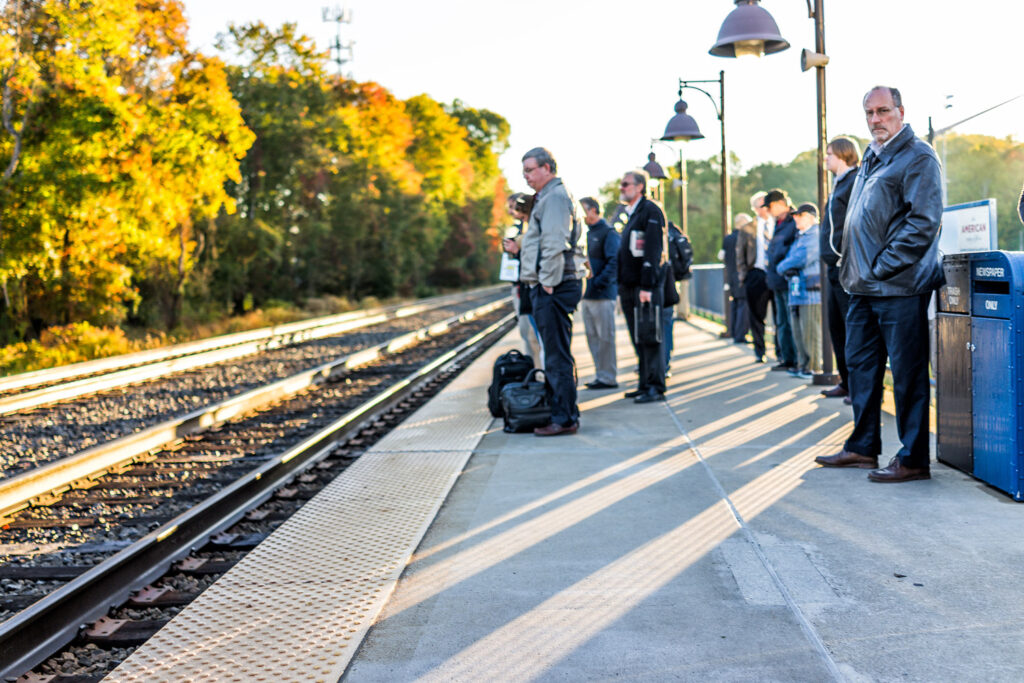
A year or two into the first Trump administration, it started to become clear that the Federal Transit Administration was slow-walking transit project grants, using obfuscatory language to mislead the public and Congress about what they were up to. They mixed up terms like “awarded,” “advanced,” and “obligated”—terms with very different legal meanings when it comes to the status of grants. T4America once again stepped in, creating a tool we called “Stuck in the Station,” which tracked how much funding was available for transit projects and what proportion was actually obligated to projects with signed grant agreements. The web page also included a great photo of a no-nonsense train commuter from a New York City suburb (relatable to this writer, originally from New Jersey), looking annoyed that his fricking train hasn’t arrived yet. Our work provided sunlight and accountability so that members of Congress could pressure the administration to sign full-funding grant agreements, get funding obligated to transit projects, and get transit projects built in their districts. (We’re going to need to replicate this campaign and transit grants moving once again: The Trump administration has yet to advance a single transit capital project in their tenure so far, a new record for slowness.)
When the COVID-19 pandemic started to dramatically impact lives in the early spring of 2020, we quickly realized that this would be a crisis for public transit. Most Americans were staying home in lockdown, and the whole economy was shutting down. Overnight, transit agencies lost almost all of their fare and sales tax revenue. But transit couldn’t shut down because essential workers still needed it to get to jobs that enabled us to eat, access the hospital, have drinking water and sewage, and other essential services until we flattened the infection curve enough to open back up. Transit agencies were about to go broke. The American Public Transportation Association (APTA) made a tepid call for Congress to pony up $12.9 billion. We could clearly see that it was nowhere near enough. Eventually, our ask of $25 billion was included in the CARES Act, and Congress went on to pass two more tranches of aid, for a total of $69.5 billion.
3. You won’t see the cracks until the wall breaks
When I ponder how the smart growth movement can break through and radically change our built environment for the better, I look to the gay rights movement. In 2008, California passed Proposition 8, which banned gay marriage. Thanks to the hard work of many, less than five years later, the Supreme Court ruled the measure unconstitutional, and public opinion quickly shifted such that a gay marriage ban was almost unthinkable in most states by that point.
We won’t necessarily know when a rapid, sudden shift in the smart growth movement is coming. But there are signs it could be soon. I mentioned the market conditions, polling, and work of local leaders above. The housing reform movement, in particular, has passed powerful legislation at the state level that is changing the rules on the ground for delivering more housing where people need it. More than 5,000 places have reformed parking requirements.
Underlying all these victories is a change in the way people see things. For example, SGA Senior Policy Advisor John Robert Smith and Chris Zimmerman (at the time SGA’s vice president of economic development) counseled Mayor Ronny Walker of Ruston, Louisiana, on the costly trade-offs of outward versus inward growth. After this, Mayor Walker made a “180” turn-around, canceling outward annexation and focusing growth in existing neighborhoods and the downtown. He has become a champion of the movement. Once you see the wisdom of a smart growth approach, you can’t unsee it. Come to think of it, this is why I became an advocate years ago and have stayed at it. Once you see a better way of doing things, you just can't stand seeing the old ways continue!
I’m moving on to new opportunities, but I know that SGA is going to keep shining like a beacon of wisdom until the tired old ways of highway expansion and sprawl crawl away into the dark dustbin of history where they belong.
Related News





Livable places. Healthy people. Shared prosperity.


© 2026 Smart Growth America. All rights reserved
Site By3Lane Marketing
