






News
By Eileen Pomeroy, November 18, 2026
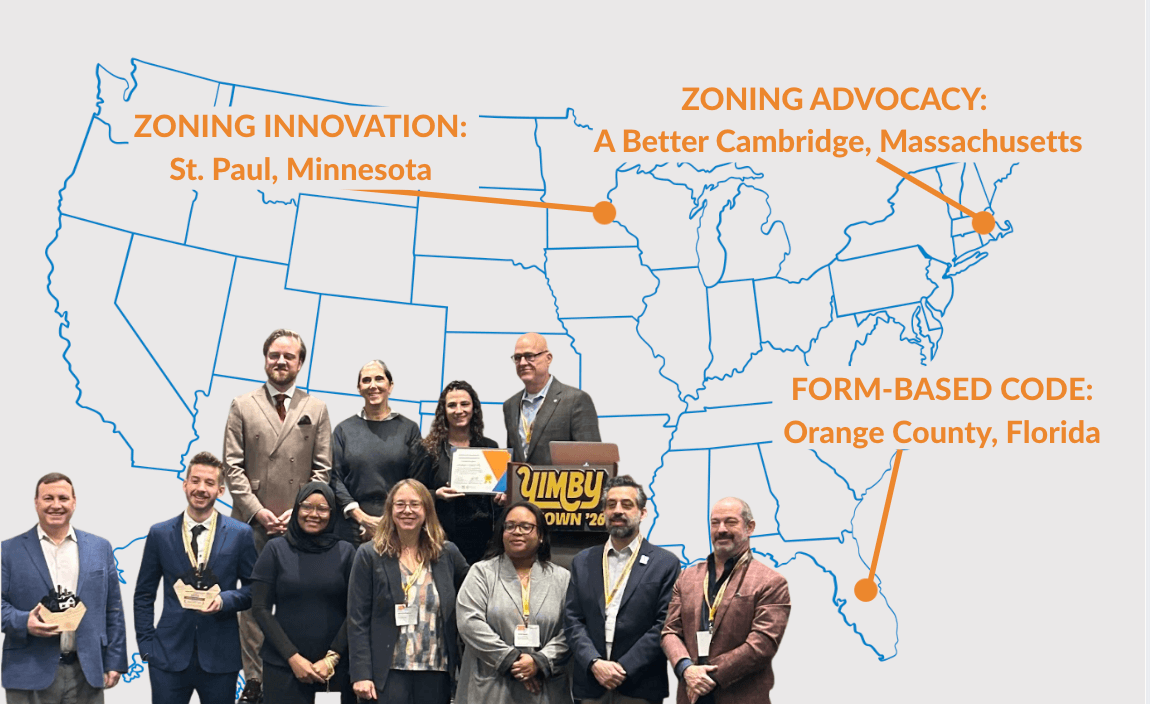
Building on our longstanding Form-Based Code Award, the inaugural Center for Zoning Solutions (CZS) Awards expand our recognition to include outstanding work in Zoning Advocacy and Zoning Innovation that helps communities address the housing affordability crisis. In addition to celebrating local leaders and proven approaches, the CZS Awards highlight successful examples for other communities across the country.
Form-Based Code Award Winner: Orange County, Florida
For 18 years, SGA has recognized stellar form-based codes from across the country as best-practice models for centering residents’ needs, advancing equity, and preparing for the future, from extreme weather to population growth. This year, our jury members focused on selecting a code that fostered more inclusive development, people-oriented communities, and predictable development outcomes.
Among the three finalists, the award jury selected Orange County, Florida, as this year’s winner.

Orange County officials presented their work as one of the most ambitious applications of transect-based, form-based zoning in the country, covering an area with about 1.5 million residents, including urban, suburban, rural, and environmentally sensitive land. The winning code replaced an outdated zoning code from the 1950s and was developed alongside its Vision 2050 Comprehensive Plan to put its vision for more compact, walkable, and sustainable development into practice.
Along with its clear design standards and innovative development regulations, jury members commended its context-sensitive approach to rural and environmentally sensitive areas, making it an example of how form-based codes can work across large, geographically diverse communities.
Zoning Advocacy Award Winner: A Better Cambridge
After working with community-based organizations across the country through the Zoning for Equitable Solutions and Thriving Communities (ZEST) program, our Center for Zoning Solutions team added a new award category to recognize the individuals and community-based organizations whose leadership is critical to advancing solutions to zoning barriers.
From six finalists, the jury selected A Better Cambridge, a community-based organization in Massachusetts, as the winner of the Zoning Advocacy Award.

A Better Cambridge is a volunteer-run housing advocacy nonprofit that led the local campaign for a Multifamily Housing Ordinance, which ended zoning practices that banned multifamily homes in neighborhoods with boundaries that matched historic redlining maps. The ordinance represents one of the most significant municipal upzoning efforts in the U.S., which is particularly notable given Cambridge’s status as one of the most expensive housing markets.
As a result of their work, hundreds of new homes have already entered the project pipeline. To achieve this win, A Better Cambridge reached thousands of local residents and coordinated hundreds of public comments. Their expansive community engagement and advocacy efforts also included reaching out to local media outlets and using innovative digital strategies such as a WhatsApp group to engage young voters often left out of planning processes.
Zoning Innovation Award Winner: St. Paul, Minnesota
For the broadest award category, which could include innovative approaches to ordinances, overlays, and code updates that have delivered meaningful results, the jury narrowed the submissions to 10 finalists.
Ultimately, the jury selected St. Paul, Minnesota, for its 1-6 Unit Housing Study. This work resulted in amendments adopted in November 2023 that transformed the city’s zoning.

The reforms that resulted from the 1-6 Unit Housing Study simplified the city’s zoning rules, combining six low-density districts into two districts that allow four to six units by right. After learning from similar efforts in other cities, St. Paul officials also included intentional density bonuses for keeping existing homes, offering affordable units, or adding family-size units. Along with these creative changes, the new code caps the size of single-family homes in one district and allows two accessory dwelling units on each lot.
Legal changes to allow different building types weren’t the only innovative part of St. Paul’s approach to zoning reform. Its consultants even tested different housing types on typical city lots to make sure that new projects could move forward without special exceptions. Since adopting these changes in November 2023, St. Paul has seen a notable increase in small-scale housing development.
Thank you to every applicant who shared their work with us, and congratulations to this year’s winners! In the coming weeks, we’ll share more about each of this year’s winners and the work behind their successful zoning work. We'll also announce details about an upcoming public webinar featuring the 2026 CZS Award winners.
Related News





Livable places. Healthy people. Shared prosperity.


© 2026 Smart Growth America. All rights reserved
Site By3Lane Marketing
