





News
By Sam Gordon, May 12, 2026
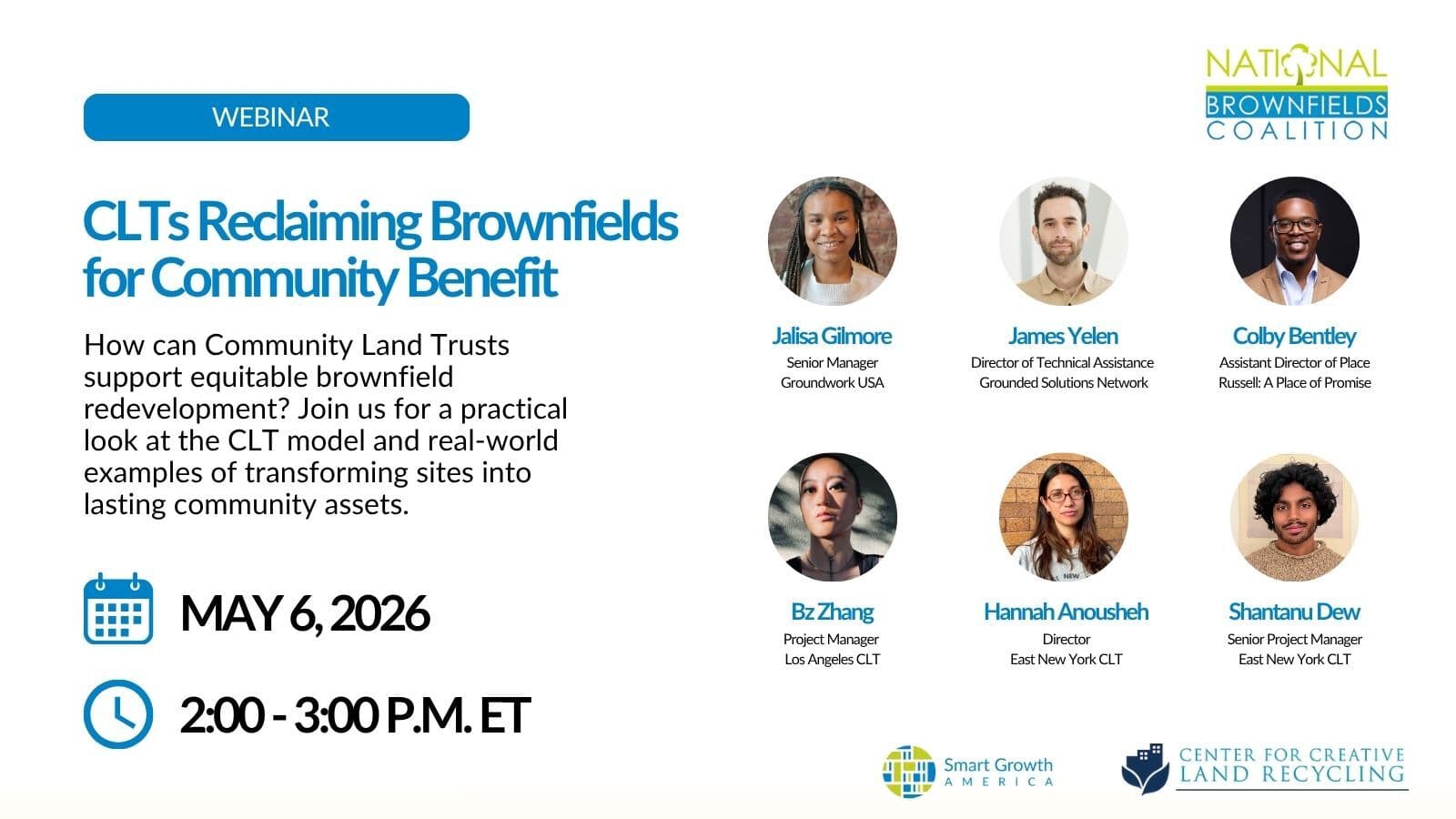
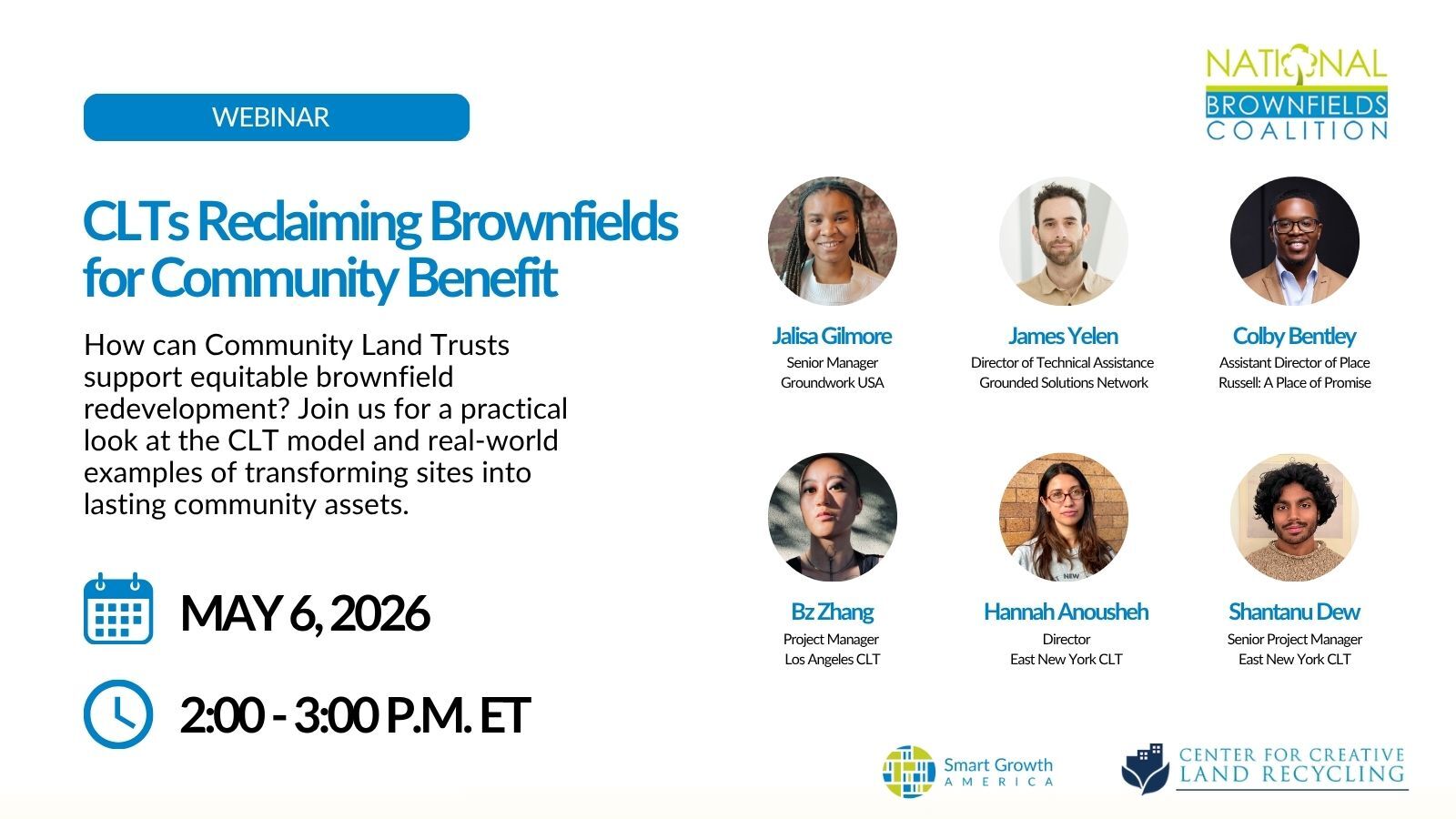
On May 6, the National Brownfields Coalition’s Community Development Committee brought together practitioners from across the country to share how Community Land Trusts (CLTs) can transform brownfields—contaminated, underutilized land—into lasting community assets. The webinar was moderated by Jalisa Gilmore, Senior Manager of Health and Land Use Programs at Groundwork USA.
Why this moment matters
Brownfields—properties where contamination complicates redevelopment—are estimated at 450,000+ sites nationwide, concentrated in many of the same communities already facing housing unaffordability and disinvestment. Federal brownfields funding has long been a rare bipartisan bright spot, but that’s at risk. With the expiration of the Infrastructure Investment and Jobs Act (IIJA), annual funding is projected to drop roughly 75%, from approximately $350 million to $98 million. With Congress currently weighing reauthorization of the EPA Brownfields Program, stories of community-driven brownfields work have never been more important to tell.
CLTs and brownfields: A natural fit
A Community Land Trust is a nonprofit that permanently owns land so that housing and other uses on it remain affordable and community-controlled. James Yelen, Director of Technical Assistance at Grounded Solutions Network—a national organization supporting over 200 organizations shared-equity housing organizations across the country—opened the discussion by explaining why CLTs are structurally well-suited for brownfields work: their long time land stewardship horizons match remediation timelines, their community governance rebuilds trust in neighborhoods that have experienced systemic harm, and their resale formulas ensure that public investments in cleanup aren’t lost to market appreciation. CLTs and land banks, he explained, are complementary tools — land banks excel at acquiring and clearing title to distressed properties, while CLTs provide the long-term community stewardship that follows.
View James’ presentation slides here
Voices from the Field
Three organizations shared community stories that bring this connection to life:
Los Angeles Neighborhood Land Trust—Los Angeles, CA
Founded in 2002, the Los Angeles Neighborhood Land Trust (LANLT) manages 30 parks and gardens across 22 acres serving 500,000 residents in a county that ranks near the bottom nationally for park access. Bz Zhang, Project Manager, shared the organization’s Jefferson Park & Affordable Housing Project: a 1.86-acre former urban oil drilling site that neighbors and community partners successfully fought to shut down in 2018 after years of organizing. LANLT acquired the site in 2023 and is currently in active remediation planning, with a youth-led restoration garden already underway and site construction planned for 2027–2028.
View Bz’s presentation slides here
Russell: A Place of Promise—Louisville, KY
Based in Louisville, Kentucky, Russell: A Place of Promise (RPOP) is a CLT and community developer focused on building Black wealth through investment without displacement. Colby Bentley, Assistant Director of Place, presented the 30th & Madison Street Redevelopment: a planned $150 million, multi-phase transformation of a long-abandoned brownfield (a former tobacco and light manufacturing site) in the predominantly Black Russell neighborhood into a mixed-use community anchor with healthcare, retail, affordable housing, and entrepreneurship space. Phase 1, a $27 million initial activation, is on track for a 2026 groundbreaking, supported by a layered funding strategy that includes brownfield remediation funding alongside tax credits, public dollars, and philanthropic capital.
View Colby’s presentation slides here
East New York Community Land Trust (ENYCLT)—New York, NY
Founded in 2020 in Brooklyn, the East New York Community Land Trust (ENYCLT) works to bring land and buildings under permanent, democratic, resident control in East New York and Ocean Hill-Brownsville — communities that saw land prices increase roughly tenfold following a 2016 rezoning. Hannah Anousheh, Director, and Shantanu Dew, Senior Project Manager, presented on two active projects: the historic acquisition of 248 Arlington Avenue (the first privately acquired multifamily building by a CLT in New York City), and 161 Jamaica Avenue, a 9,500-square-foot former manufacturing building in the process of being transformed into the East Brooklyn Liberation Center — a community-owned hub for organizing, education, and deeply affordable commercial space. Both properties required environmental due diligence, including Phase I and Phase II assessments, which came back clean and allowed the work to move forward.
View Hannah’s and Shantanu’s presentation slides here
The Bottom Line
As James Yelen noted in closing, don’t underestimate the time it takes upfront to build trust and engage communities—everything feels urgent, but that foundation is what makes the work stick. CLTs and brownfield remediation are deeply connected strategies for community-driven revitalization, and the projects shared in this webinar are proof of what’s possible when communities control land and shape their own futures. With federal funding for this work hanging in the balance, we must continue to uplift these stories and bring them to the attention of local, state, and federal policymakers.
Click this link to learn more or get involved with the National Brownfields Coalition, or contact brownfields@smartgrowthamerica.org
Related News


Livable places. Healthy people. Shared prosperity.


© 2026 Smart Growth America. All rights reserved
Site By3Lane Marketing
