







Signature reports
Dangerous by Design
After decades of preventable deaths, insufficient policy change, and broken promises, our streets are still dangerous by design.
Dangerous by Design 2026 ranks all 50 states and the largest 101 metro areas by pedestrian fatality rates. Every one of them is too dangerous for people walking.
The rest of the developed world is dramatically safer
The United States remains one of the most dangerous countries in the world for people walking and is a dramatic outlier amongst the rest of the developed world.
Countries like Japan, Germany, and the United Kingdom took the issue of roadway safety seriously with dedicated investment into proven best practices instead of doubling down on decades of lackluster initiatives, waiting for redundant research, and celebrating tiny decreases. As a result, they reduced pedestrian fatalities by 30, 20, and 10 percent, respectively, between 2014 and 2024, while the United States moved in the opposite direction.
During the same period, as other countries made their roads significantly safer, pedestrian fatalities in the U.S. increased by 45 percent, from 4,884 to 7,080.
If the U.S. took safety seriously, no agency charged with improving safety would be declaring victory after a one-year decrease of 3.9 percent, down to historic highs. Those with the power to turn the tide seem to be waiting for solutions that are already proven and ready. The nation’s pedestrian fatality rate is an indicator of the failure of its transportation system as a whole. This country cannot be distracted from the roadway safety crisis it is still firmly entrenched in.
Setting a new standard for safety and progress
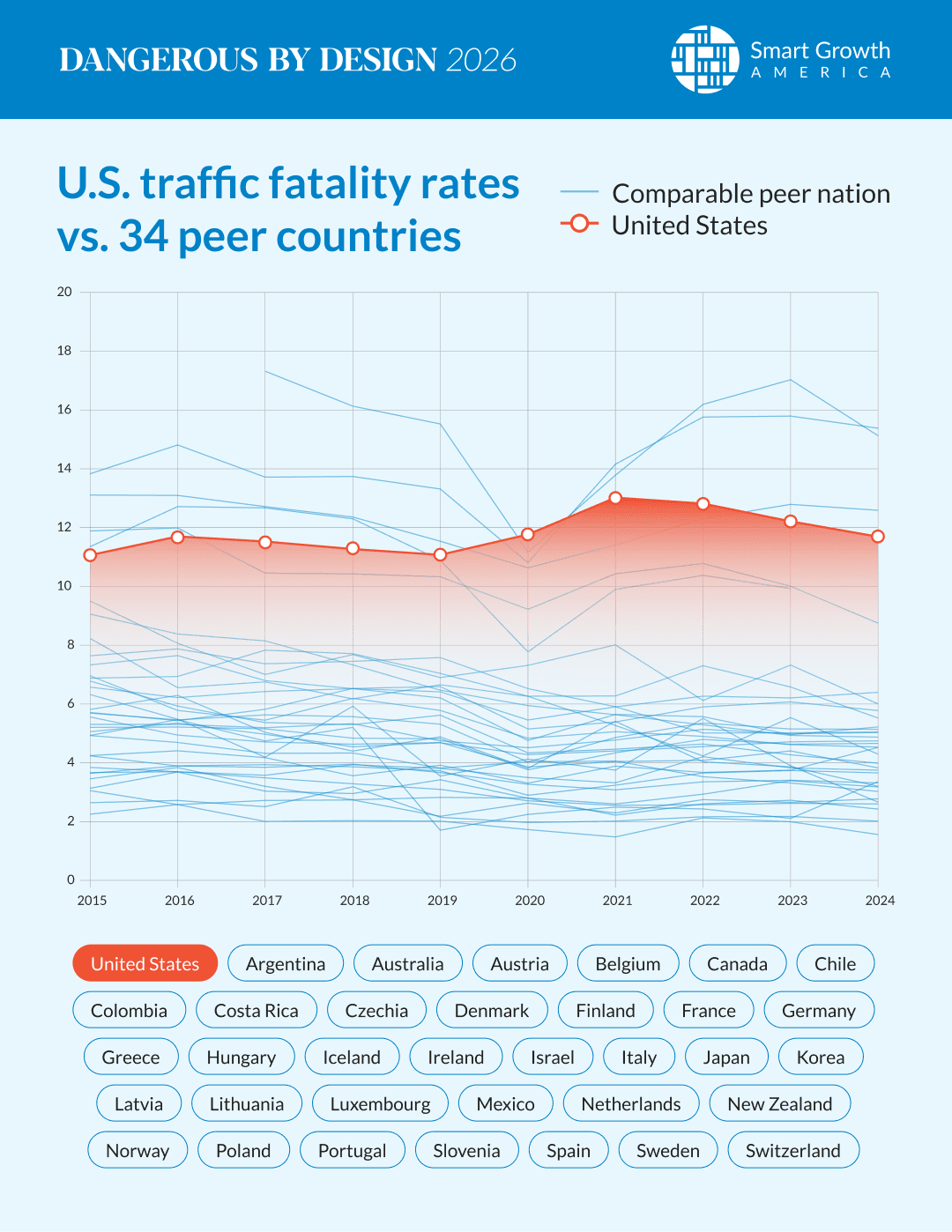
Smart Growth America is calling on policymakers, practitioners, and our own partners to adopt a new standard for roadway safety that puts the U.S. back in line with our global peers. We have calculated that if the U.S. had reduced all traffic fatalities (not just people walking) at a rate similar to that of 34 comparable peer nations, we would be at 8.73 fatalities per 100,000 people vs. our current rate of 11.7.
Reaching 8.73 deaths per 100,000 people should be the new minimum safety standard for what the U.S. considers “success” in improving roadway safety.
Until the U.S. reaches a rate of 8.73 fatalities per 100,000 people, there’s no reason to celebrate.
These peers, representing 34 countries from Asia, Europe, Australia, Central and South America, have been making consistent progress while the United States has inched further and further away from the pack.
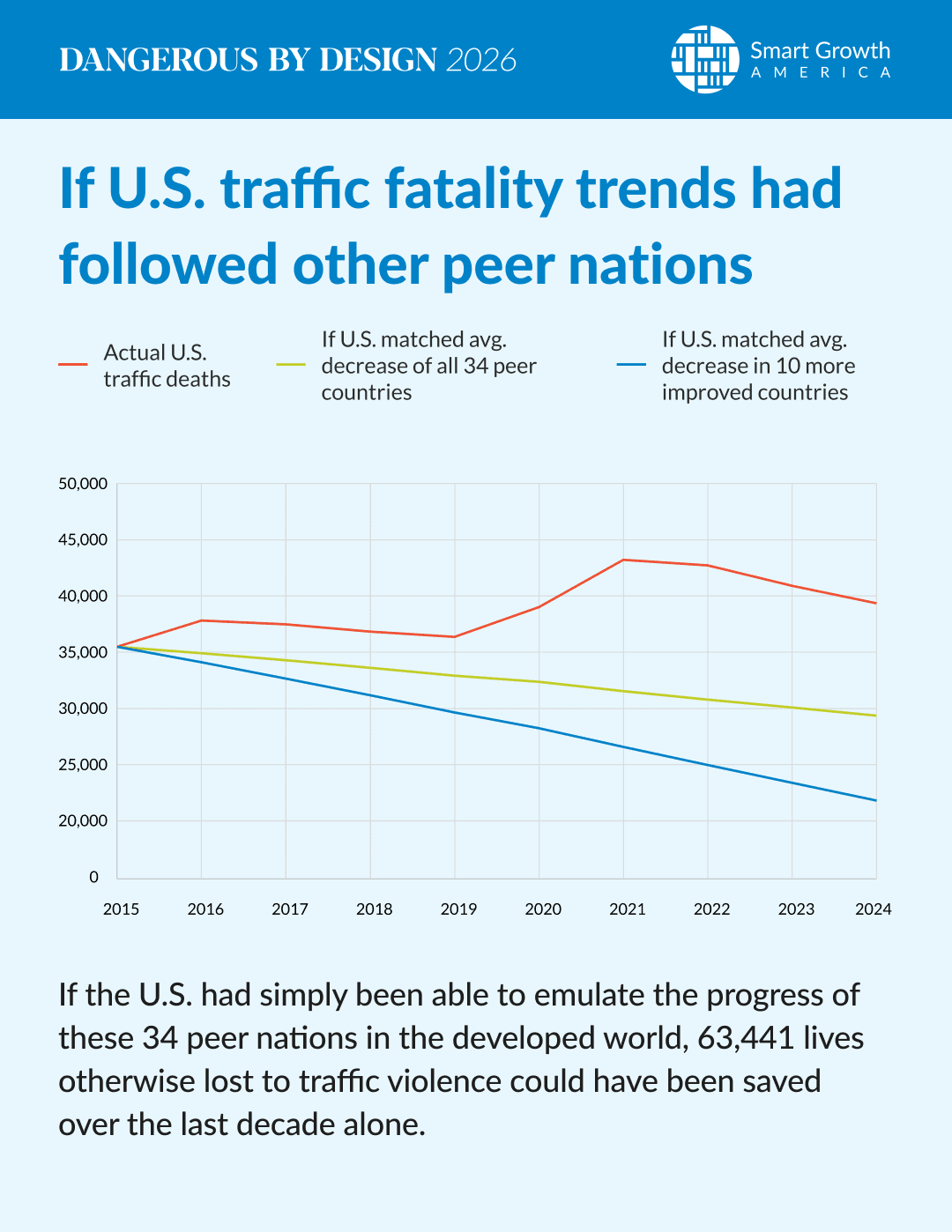
If the U.S. had simply been able to emulate the progress of these 34 peer nations in the developed world, 63,441 lives otherwise lost to traffic violence could have been saved over the last decade alone.
Norway, which has the lowest roadway fatality rate in the world, reduced fatalities by 31 percent between 2015 and 2024. That represented 30 fewer deaths. If the U.S. had reduced fatalities by 31 percent over ten years, we would have saved 12,000 lives.
We cannot be paralyzed by the enormity of this problem, but the United States needs a new benchmark to assess our progress. Until the U.S. reaches a rate of 8.73 fatalities per 100,000 people, there’s no reason to celebrate. While zero traffic deaths might be the ultimate goal, simply keeping pace with our global peers should be considered the bare minimum and is entirely attainable.
Other countries took decisive action. The U.S. made plans and crossed its fingers.
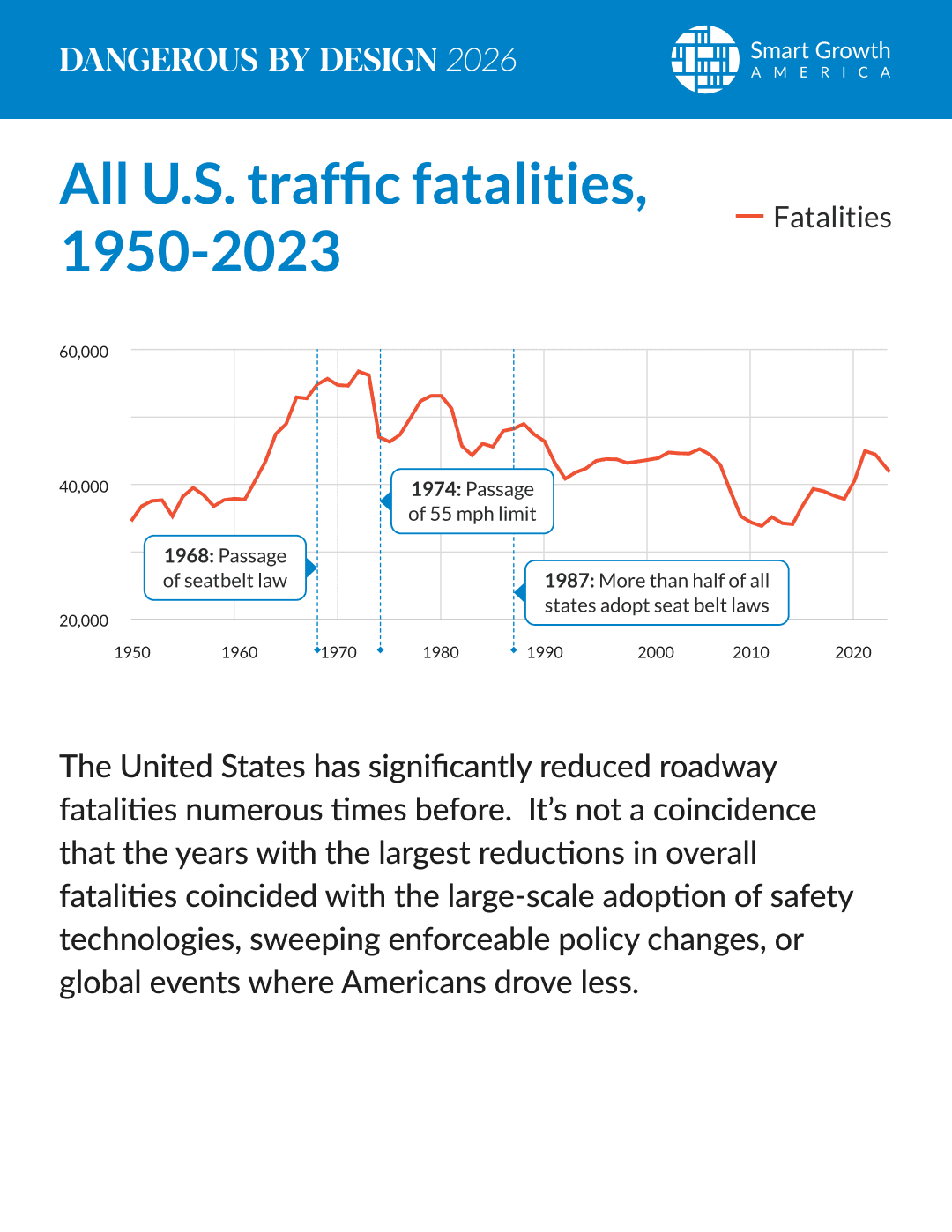
The United States has significantly reduced roadway fatalities numerous times before. It’s not a coincidence that the years with the largest reductions in overall fatalities coincided with the large-scale adoption of safety technologies, sweeping enforceable policy changes, or global events where Americans drove less.
Other countries have reduced speeds, invested in active transportation, and incentivized transit use. They’ve installed miles of protected bike lane networks and created vibrant pedestrian plazas, clearly communicating that people walking and biking are to be prioritized and celebrated.
The U.S. has put the onus of safety on the people most likely to be killed, using opportunities like National Bike Month and National Pedestrian Safety Month to remind individuals to use helmets and wear reflective gear.
Catching up will require an investment that recognizes how far we’re behind
Saving lives on U.S. roads isn’t impossible. Other countries have done it. The United States has done it before. The challenge is whether we are willing to implement proven solutions at the scale required to achieve it.
There have been moments where we could have charted a different path. For example, the historic investment made in the Infrastructure Investment and Jobs Act (IIJA) could have drastically changed streets across the country, redefining what a successful transportation system means in the twenty-first century.
Instead, safety was once again siloed as the specific purpose of small programs, rather than the top priority of the entire program, and Congress doubled down on the same overall approach that has produced some of the worst roadway fatality rates in the developed world.


Livable places. Healthy people. Shared prosperity.


© 2026 Smart Growth America. All rights reserved
Site By3Lane Marketing
